A Basketball Screen Has Two Readers
A basketball screen is easier to read when you track the ball-handler and the defender: spot the coverage, predict the next pass and catch the real advantage.
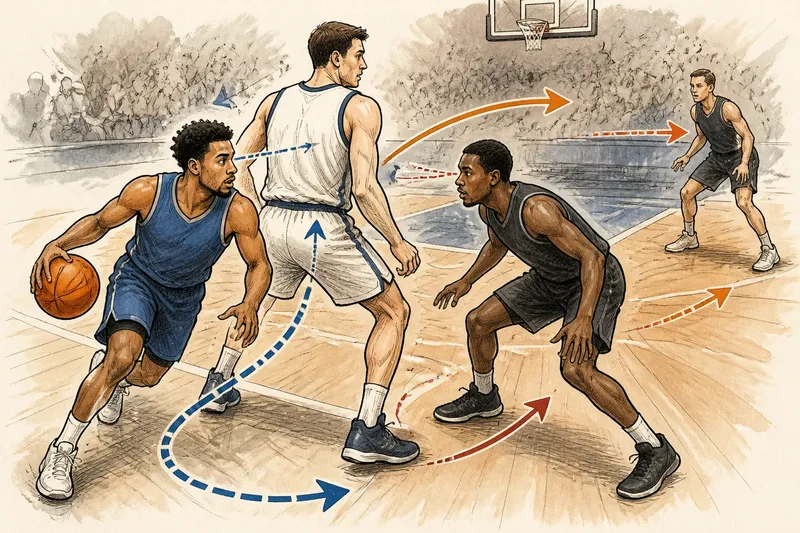
When a basketball screen comes, should you watch the ball-handler or the defender? Watch both, in turns: the player using the screen shows where the attack wants to go, while the defender’s response reveals what the defence is willing to concede. That two-reader habit makes a pick-and-roll easier to follow than treating the screen as one isolated block.
Start with the ball-handler’s route
A screen, also called a pick, is a teammate’s stationary position intended to impede a defender’s path. In a common pick-and-roll, the screener stands near the ball-handler’s defender; the ball-handler dribbles close past the screener, who then moves towards the basket. The route around the screen is your first clue, not the whole answer.
Look for the angle. Does the ball-handler use the screen tightly, turning towards the middle, or reject it and drive the other way? A tight turn can make the defender trail behind. A rejected screen may catch that defender leaning towards the expected route. Neither choice automatically creates a scoring chance: help defenders and the screener’s next movement still matter.
For a moment, follow the ball-handler’s eyes and shoulders. A player who turns the corner may be looking at the rim, a teammate in the corner or the screener rolling towards the basket. The pass is often as revealing as the dribble: it shows which defender has been pulled out of position, or which opening the offence wants to use.
Read the defender’s response by situation
The defender guarding the ball-handler has several broad responses. Names vary between teams, and a defence can change its approach during the same possession, but these patterns give spectators a useful first read.
- If the defender follows behind: The screen has delayed their direct route to the ball. Watch whether a second defender steps into the ball-handler’s path; if not, the handler may have room to turn the corner and attack.
- If the defender goes over the screen: They chase around its upper side, often trying to stay close to a player who can shoot from range. The handler may continue towards the basket, but a trailing defender can pressure from behind.
- If the defender goes under: They slip beneath the screen to meet the ball-handler on the other side. This can protect the route to the basket, but it may leave the handler space to shoot. Check what the handler does with that space before deciding who benefited.
- If the defender switches: The screener’s defender takes the ball-handler, and the original defender turns to cover the screener. The attack may now seek a mismatch, such as a quicker ball-handler facing a larger defender, though help can arrive before it becomes useful.
- If a second defender steps up: Two defenders briefly confront the ball-handler, an approach often called a hedge or trap depending on how aggressively the second player commits. Look for the pass out to the screener or an open teammate, then see whether the defence recovers.
These responses are easier to understand if you track the defender’s feet and chest, not just the ball. A defender who squares up in front of the handler may be containing the drive; one who turns and chases may be trying to recover from behind. The difference helps explain why the same screen can lead to a pass on one possession and a drive on the next.
Follow the screener after contact
Once the ball-handler passes the screen, shift your attention to the screener. If they turn and run towards the basket, that is a roll. If they move out towards the perimeter instead, that is a pop. The defence’s response to that movement tells you whether the screen created a second problem after the first defender was delayed.
Say a hypothetical ball-handler uses a screen near the top of the key, and the defender guarding them trails while the screener’s defender steps forward to contain the drive. The handler can look to pass to the screener rolling towards the rim; if another defender drops to cover that route, a teammate on the wing may be left open. The useful viewing question is not merely “Did the handler get past the screen?” but “Which defender had to leave someone, and who can receive the ball next?”
In a hypothetical alternative, the screener pops towards the three-point line as the handler draws both defenders. Watch whether the screener’s defender follows out or stays near the basket. That choice can open a perimeter pass or leave the handler a lane, but the offence still has to recognise the opening and make a sound pass.
Choose what to watch when the play gets crowded
If you lose track of the action, pick one question to answer rather than trying to follow every player at once. The right focus depends on what you want to understand.
- To see whether the screen worked: Watch the ball-handler’s defender. Did the screen delay or redirect them, or did they stay attached to the handler?
- To understand the defence’s plan: Watch the screener’s defender. Do they stay back, switch onto the handler or step out to meet the ball?
- To predict the next pass: Watch the screener after the handler turns the corner. A roll or pop can become the next target if a defender commits to the ball.
- To judge the quality of the opening: Look beyond the immediate matchup. A pass may be available but difficult, or the defence may have recovered before the receiver can act.
It is not worth trying to name every defensive scheme in real time. Coaches may combine or disguise coverages, and a single possession may not fit a tidy label. A plain description—“the defender went under, then the big stepped up”—is often more accurate and more useful than guessing a system’s name.
What should you watch when a screen happens?
What does it mean when a defender goes under a screen?
The defender moves below the screener rather than chasing around the top, aiming to get back in front of the ball-handler. Watch whether the handler takes the offered shooting space or keeps moving until another defender closes it.
What is the difference between a hedge and a switch?
In a switch, the two defenders exchange assignments: the screener’s defender takes the handler, and the original defender covers the screener. In a hedge, the screener’s defender steps towards the ball temporarily, then aims to recover rather than simply taking over the matchup.
Why does the screener roll to the basket?
The roll gives the ball-handler a teammate moving towards the rim after the screen. It can draw a defender away from another attacker, so watch both the passing lane to the roller and the space that defender leaves behind.
What does it mean when a screener pops?
The screener moves out towards the perimeter instead of cutting to the basket. This gives the handler a possible pass outside, while asking the screener’s defender to choose between stepping out and protecting the interior.
Keep both readers in view
A basketball screen is easiest to read as a short sequence: the handler chooses a route, the on-ball defender responds, and the screener’s defender decides whether to help. Then the screener rolls or pops, and the ball-handler looks for the next opening. If you remember only one thing, follow the defender who has to make the difficult choice; that is often where the possession’s real advantage begins.