Why Tennis Matches Use Tiebreaks When a Set Stalls
Why tennis matches use tiebreaks: see how a close set reaches a decision, what the format changes, and why the tiebreak became part of tennis.
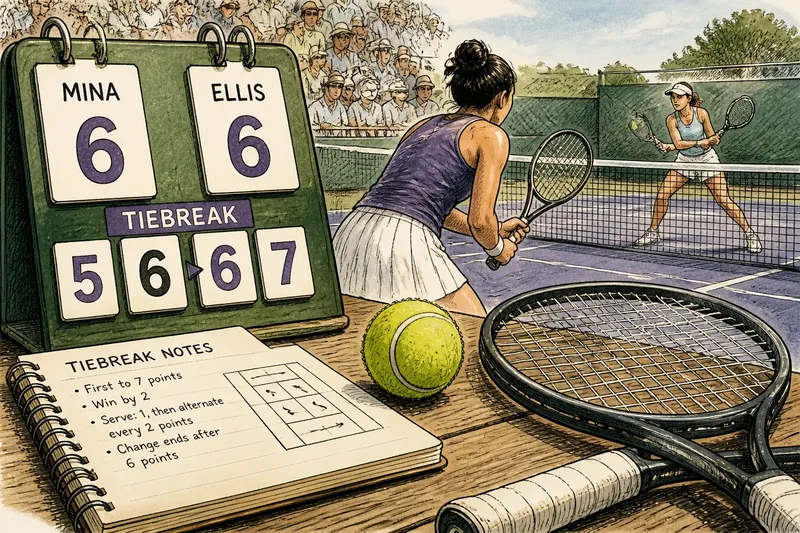
Why tennis matches use tiebreaks becomes clear when a set reaches six games apiece and neither player can create a two-game lead. Imagine a hypothetical match in which both players keep holding serve: the score is level, the rallies remain tense, but the ordinary set format has no natural finishing point until one player pulls clear. A tiebreak gives that close set a compact way to reach a result.
A close set needs a different kind of finish
In a standard advantage set, a player must win six games and lead by two. At six games all, play continues; if the next games are shared, so does the stalemate. The rule rewards a clear margin, but it can keep a set alive for a long time when both players repeatedly protect serve.
A tiebreak changes the scoring method rather than simply adding another ordinary game. Players count points towards a target, usually needing to reach at least seven points with a two-point lead in a conventional set tiebreak. If the score reaches the target without that margin, the points continue until someone earns it.
That format preserves a decisive finish: one player must still win by two. Yet it replaces the open-ended sequence of games with a defined contest inside the set. The point-by-point score also gives spectators a simple marker of how near the set is to resolution.
The invented match shows what changes
Say two fictional players, Mina and Ellis, arrive at six games all after trading service holds. Mina has served well under pressure; Ellis has returned sharply, but neither has managed a break that would open a two-game gap. The set has produced close tennis, not a lack of effort or a failure of the scoring system.
They begin the tiebreak, and the points are counted one by one. Ellis takes an early lead, but Mina steadies her serve and draws level. At the target score, the margin is still only one point, so the tiebreak continues; Mina then wins the next point and takes the set by a two-point margin.
The lesson is not that a tiebreak makes every set shorter or fairer in every possible sense. It gives the set a planned endpoint while retaining a small requirement for separation. A player still has to win the decisive points, but the contest no longer depends on extending the ordinary game sequence until a two-game lead appears.
It also changes the feel of pressure. In ordinary games, points contribute to holding or breaking serve; in a tiebreak, every point directly shifts the running score. A missed return or a successful second serve can alter the immediate position without waiting for a game to finish.
The format reshapes tactics without erasing them
Serve order and court ends matter, but their precise arrangement can differ by format. In many familiar tiebreaks, one player serves the opening point, then service alternates in short turns. Players also change ends at set intervals, which gives both competitors a turn facing different conditions such as sun or wind.
Those details make a tiebreak feel like a miniature match with its own rhythm. A strong first serve may offer a direct point, while a cautious second serve can invite the opponent to attack. The receiver, meanwhile, may choose to target depth and height rather than gamble on a spectacular winner.
The score can encourage either patience or urgency. A player who leads may favour reliable placement and make the opponent produce the riskier shot; a player behind may look for an early opening. Neither approach is automatically correct, because surface, serving skill and the opponent’s return position all shape the choice.
What is not worth the effort is treating a tiebreak as a separate sport with a single secret tactic. The same foundations still matter: serve placement, depth, movement and decision-making. The scoring simply makes each point’s consequence easier to see.
Why tennis adopted a set-deciding format
Tennis developed its tiebreak as a response to the possibility of very long advantage sets. A format that required a two-game lead could produce extended play when competitors kept holding serve, leaving a set without a predictable stopping point. The tiebreak offered a bounded contest that could settle such a score while keeping the requirement for a two-point margin.
Its adoption was gradual rather than a single universal switch. Tennis bodies and competitions have used different approaches, and the details have changed over time: some sets use a tiebreak at six games all, while particular formats may reserve a longer deciding tiebreak for the final set. The central idea, though, remains recognisable: replace endless game-by-game extension with a point-based decision.
That compromise affects more than the players. Spectators can follow a closing sequence with a clear score, and organisers can plan play around a more predictable set ending. But a tiebreak also means the set’s outcome may turn on a short burst of points rather than another extended run of games. It is a trade-off between the drama of open-ended resistance and the practical value of a defined finish.
What should you look for as a tiebreak begins?
Why does the score reach six games all?
Both players have won six games, so neither has the two-game lead required to take an advantage set. A tiebreak is one common way to resolve that close score, though the applicable format can vary.
How does a player win a conventional tiebreak?
The player must reach at least seven points and lead by two. If the score is close at that point, play continues until the two-point gap appears.
Why do players change ends during the tiebreak?
Changing ends helps distribute conditions such as wind and sun between the competitors. The interval and service pattern depend on the tiebreak format being used.
Does every tennis set use the same tiebreak?
No. Rules may differ between competitions, and deciding sets can have their own arrangements. For a live match, the event’s published rules explain which format applies.
In the invented match, Mina’s final point mattered because it completed the required margin, not because a tiebreak erased the contest that came before it. That is the useful way to read why tennis matches use tiebreaks: they turn a set that has resisted a clear finish into a compact, still-earned decision, while leaving the exact format to the rules of the competition.