The Setter’s Work Before Volleyball’s Attack
Volleyball setter decisions turn a first contact into an attacking choice. Learn how pass quality, hitter availability, rotation and timing shape the play.
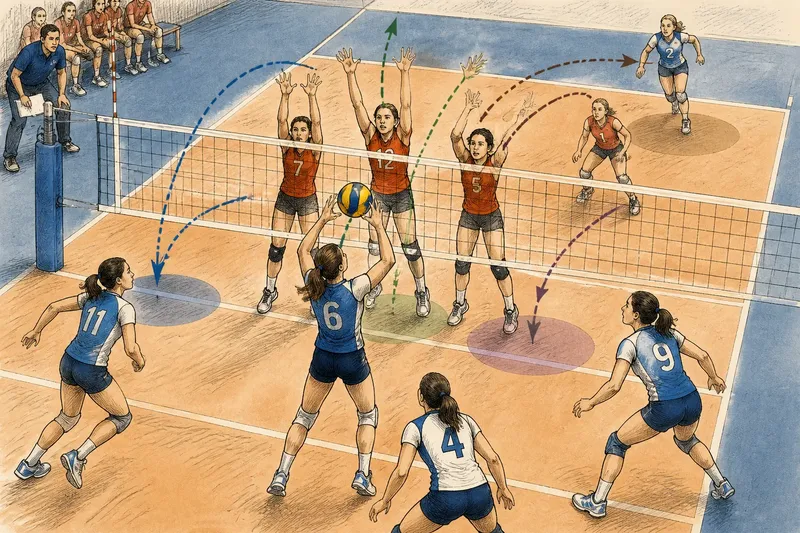
How does a volleyball setter turn a difficult first contact into an attack a teammate can use? Volleyball setter decisions begin before the hands meet the ball: the setter reads its path, checks which hitters can arrive on time and chooses a set that fits the play taking shape.
The set is not simply a pass to the tallest or most powerful attacker. It is a decision made while players are moving, with the setter trying to give a hitter a playable ball and make the opposing block respond to more than one possibility.
The first contact shapes the setter’s options
A serve receive is often intended to send the ball towards the setter’s usual operating area near the net. A pass that arrives close to this target gives the setter room to organise several attacking options; one that drifts away narrows the choices.
The setter reads the ball’s height, speed and distance from the net. A low pass may leave little time to get beneath it, while a pass tight to the net can risk crossing over or being played by an opposing blocker. A ball pushed far from the net may still be set, but the hitter’s approach and available angles change.
“Good pass” and “bad pass” are useful shorthand, not complete descriptions. A pass can be imperfect yet playable if the setter reaches it in balance. A ball that looks close to the target can still be awkward if it arrives behind the setter or forces a late turn.
The setter moves while keeping the attack in view
After the pass, the setter works to get beneath the ball and deliver it from a position that keeps the attack organised. The ideal location is not a fixed spot: it depends on the pass, the setter’s movement and where the front-row hitters are preparing to attack.
Footwork helps the setter control the direction and height of the set. If the setter arrives early, settles and faces the intended target, the ball is easier for a teammate to read. If the setter has to chase, jump or turn sharply, a quick set may no longer be realistic. The choice shifts towards what can be delivered cleanly now, rather than what the team planned before the serve.
The setter is tracking teammates, too. A middle hitter may approach close to the setter for a quick attack; an outside hitter may build an approach near the left antenna; a right-side hitter may be available on the opposite pin. The useful question is which options remain credible after this particular pass.
Each attacker offers a different route
A set to the middle is usually quick and close to the setter, asking the hitter to time an approach around the ball’s arrival. It can draw the opposing middle blocker away from the pins. That threat can matter even when the setter sends the ball elsewhere, because a blocker may hesitate or commit early.
The outside hitter, attacking from the left side, often provides a workable route when the pass is less precise. The ball can be set higher, giving the hitter more time to organise an approach. The defence may also have more time to assemble a block, so the hitter’s possible shots—across court, down the line or a controlled roll—remain part of the decision.
A right-side set stretches the opposing defence in the other direction and may suit the team’s available players. Back-row attacks add another route: the hitter approaches from behind the attack line and must take off without stepping on or over that line before contacting the ball. The set is useful only if its location and timing let the attacker reach it legally and in rhythm.
Rotation changes what a back-row setter can attack
Rotation determines whether the setter is a front-row or back-row player. A back-row setter may move towards the net to set, but that movement does not change their rotational status. Under standard indoor volleyball rules, the setter may not complete an attack hit from the front zone if the ball is entirely above the top of the net at contact, and may not complete a block or take part in a completed block.
That restriction is about the setter’s own attack and blocking actions, not the act of setting. A back-row setter can deliver the second contact near the net, but if they jump and send the ball over while it is entirely above the net, they commit a back-row attack fault. If the ball is below the top of the net at contact, that specific restriction does not apply; local competition rules can vary, so players should follow the rules used in their event.
A front-row setter does not face that back-row attack restriction and can attack or block subject to the ordinary rules. Rotation therefore changes the setter’s available threat: opponents may have to respect a front-row setter’s possible second-contact attack, while a back-row setter has to set or choose a legal alternative.
The setter reads the blockers and the approach
As the setter prepares to release the ball, the opposing team is also making decisions. A middle blocker may move towards the middle hitter, stay central or try to read the setter’s hands. The outside blockers adjust in response. The setter is choosing not just a hitter, but a route through a defence that is still assembling.
If the opposing middle blocker commits towards the middle, a set to an outside hitter may leave that attacker facing fewer blockers. If the middle stays home and the outside block closes quickly, another hitter or tempo may look more attractive. These are cues, not promises: blockers can recover, and a hitter may still have an answer against a formed block.
The quality of the attacking approach matters as much as the planned play. A teammate who is late, crowded by another player or forced to shorten the run-up may not be the best target, even if that hitter is normally the first choice. A clear, balanced approach can make a modest set more useful than an ambitious ball that arrives at the wrong moment.
Timing has to belong to the hitter
Tempo describes how quickly the ball reaches the attacker in relation to the approach. A fast set can make it harder for blockers to organise, but speed alone is not the goal. The hitter must be able to match the ball with the steps and jump they have practised.
Different hitters may prefer different set heights and locations. The setter and attacker build a shared understanding of those preferences in practice, then adjust when the pass changes. On a clean pass, the setter may use a quick combination. On a pass that pulls the setter away from the net, the same hitter may need a higher ball or another attacker may take over.
Say a team’s serve receive sends the ball well away from the net, and its middle hitter is already preparing a quick approach. The setter chases the pass, sees the middle slow down and notices that the outside hitter has a clear, balanced approach. In this invented situation, the setter chooses a higher ball to the outside. The observable trade-off is that the hitter can make a fuller approach, while the opposing defence has more time to form a block.
What does the setter do when the play changes?
Does the setter always take the second contact?
No. Another teammate may take the second contact if the pass pulls the setter away or makes a controlled set difficult. The priority is to keep the ball playable and give a teammate an attacking chance.
Why is a high outside set useful after a poor pass?
A higher ball gives the outside hitter more time to organise an approach and can be easier to control after a disrupted pass. The trade-off is that defenders also have more time to position themselves, so the hitter may need to vary the shot or use the block.
Can a back-row setter attack the ball?
Yes, but the attack restriction depends on where the setter takes off and contacts the ball. A back-row setter may not complete an attack hit from the front zone when the ball is entirely above the net at contact, although a legal attack from behind the attack line is possible if the player takes off without touching or crossing that line before the hit.
What makes a play out of system?
An out-of-system play is one where the first contact or subsequent movement prevents the team from using its usual attacking structure. The setter may be displaced, a hitter may be unavailable, or both; the team then relies on the most workable option rather than its preferred combination.
Watch the choices that keep an attack alive
A setter does not control every part of the rally. The first contact, teammate movement and opposing block all shape what is possible. The setter’s job is to recognise those limits early enough to deliver a ball that matches an attacker’s timing and gives the team a chance to continue if the first swing is defended.
For a spectator, follow where the pass sends the setter, which hitter has a genuine approach and how the opposing middle blocker moves. That makes volleyball setter decisions easier to read: the attack begins with the setter identifying which option still fits the ball in front of them.
There is little value in trying to name every set variation from the stands. Watch whether the hitter can approach in rhythm and whether the blockers are forced to choose; those visible clues tell you more about the setter’s decision than the label attached to the play.