How to Read the Offside Line at the Moment of a Pass
Learn how to read the offside line at a teammate’s touch, compare the right body parts and opponents, and tell an offside position from an offence.
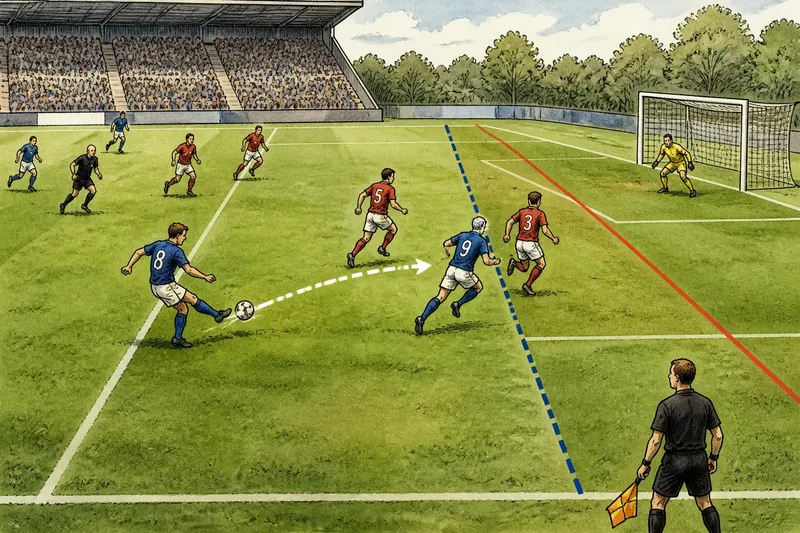
Why can a forward look level with a defender, sprint on to a pass and still be called offside? To read the offside line, start at the instant a teammate plays or touches the ball, then compare the attacker with both the ball and the second-last opponent. It is a useful snapshot, but not one fixed stripe across the pitch: different players and body parts may sit at different distances from the goal line.
A player is in an offside position only if they are in the opponents’ half and nearer to the opponents’ goal line than both the ball and the second-last opponent at that instant. Being in that position alone is not an offence. The player must also become involved in active play in a way covered by the Laws of the Game.
Fix the moment before judging the run
The important question is not where the attacker is when the pass arrives. It is where they are when their teammate plays or touches the ball. A runner can move beyond a defender between those moments without changing the position that matters for the original pass.
Say a midfielder releases a through-ball while a forward is level with the second-last opponent. The forward then sprints beyond the defender before collecting it. The decision on position is based on the forward being level when the ball was played, not on where the forward ends up.
For a replay, find the teammate’s contact first. Then assess the positions at that instant. The start of the run, the ball’s arrival and a defender’s later movement do not replace that moment.
Compare the ball and the second-last opponent
The reference is not automatically the last defender. The goalkeeper counts as an opponent, so if the goalkeeper is out of position, another defender may be the second-last opponent. The ball matters too: the attacker must be nearer the goal line than both the ball and that opponent to be in an offside position.
The comparison also does not use every part of the body. The head, body and feet can count if they can be used to play the ball; the hands and arms do not. An arm reaching forward cannot make an attacker offside, and an arm behind the line cannot keep them onside.
Imagine a defender has stepped forward while the goalkeeper remains behind the play. At the teammate’s pass, an attacker is nearer the goal line than the ball and the second-last opponent. That attacker is in an offside position, even if the defender ahead of them looks like the only relevant marker. To read the scene, locate the ball, count opponents from the goal outwards, and compare the attacker’s playable body parts.
Position alone does not make an offence
A player in an offside position is penalised only if they become involved in active play. That can mean playing or touching the ball, interfering with an opponent, or gaining an advantage from a rebound, deflection or save in circumstances covered by the Laws.
An attacker can be beyond the line while a teammate passes elsewhere and play continues. The position is not a penalty by itself; the referee must judge whether the player becomes involved in an offside manner.
Interfering with an opponent can include obstructing their line of vision or challenging them for the ball. Merely standing nearby does not settle the call. On a crowded cross, look at what the attacker does and whether that action affects an opponent’s ability to play.
Read an opponent’s touch in context
A defender’s touch does not always reset the offside assessment. The Laws distinguish a deliberate play by an opponent from a deflection or a deliberate save. A deliberate play can reset the assessment, while a deflection does not have the same effect; an attacker may still be penalised for gaining an advantage from it.
“Deliberate” does not simply mean that the defender touched the ball. Officials consider the action and whether the opponent had control or an opportunity to play it. A save is treated differently: a player who was in an offside position can still offend by gaining an advantage from the ball after an opponent’s save.
When the sequence is unclear, trace it backwards. Identify the previous touch, judge whether the opponent deliberately played the ball or merely deflected it, and check the attacker’s position at the teammate’s earlier touch. A replay can look like a fresh attack while still belonging to the same offside phase.
Know which restarts have an exception
A player cannot be penalised for receiving the ball directly from a goal kick, throw-in or corner kick. The exception applies to that direct reception, not to every later pass in the move.
After the restart recipient plays the ball to a teammate, assess the next pass in the usual way. An attacker who receives directly from a throw-in may be protected by the exception, but a later teammate’s pass creates a new moment for judging position. Ask which touch delivered the ball to the attacker, rather than stopping at the fact that a restart occurred.
Why does the decision seem to change?
Can a player run past a defender after the pass?
Yes. If the player was level with or behind the relevant line when a teammate played the ball, moving beyond the defender afterwards does not make that original position offside. The later movement can still matter if the player becomes involved in play.
Can a defender’s later movement change the call?
No. The decision uses the positions at the teammate’s touch. A defender’s movement before that instant can affect the comparison, but movement afterwards cannot retrospectively place an attacker offside.
Why might the assistant referee delay a flag?
During a developing attack, an assistant referee may wait until a player in an offside position becomes involved before signalling. The delay gives the situation time to resolve; it does not move the relevant instant to a later point.
Can a player be penalised without touching the ball?
Yes. A player can be penalised for interfering with an opponent without touching the ball if the action meets the rule’s conditions. Look for an effect on an opponent’s vision, movement or ability to play, rather than assuming that every nearby attacker is involved.
Use a replay order that separates each decision
Work through the sequence from the teammate’s touch to the attacker’s involvement. For each check, the result determines what to examine next:
- Check the touch: identify when a teammate played or touched the ball; if the moment is unclear, review the passage before judging position, or leave the call unresolved.
- Check the attacker’s half: if the attacker is in their own half, there is no offside position; if they are in the opponents’ half, compare the remaining positions.
- Check playable body parts: if only a hand or arm appears ahead, do not use it to establish offside; if the head, body or feet are ahead, include those parts in the comparison.
- Check the ball: if the attacker is not nearer the goal line than the ball, they are not in an offside position; if they are nearer, compare them with the second-last opponent.
- Check the opponents: if the attacker is level with or behind the second-last opponent, they are not in an offside position; if they are nearer the goal line than that opponent as well as the ball, assess involvement.
- Check involvement: if the attacker does not play the ball, interfere with an opponent or gain an advantage, an offside-position finding alone does not justify an offence; if one of those forms of involvement occurs, assess the specific action.
- Check intervening touches: if an opponent deliberately plays the ball, consider whether that resets the assessment; if the touch is a deflection or save, assess whether the attacker gains an advantage instead.
- Check the restart: if the ball came directly from a goal kick, throw-in or corner kick, apply the exception; if a teammate makes a later pass, assess that new touch normally.
Imagine a forward chases a chipped pass. In this invented situation, the midfielder’s kick is clearly visible, and the forward is level with the second-last opponent at that moment. First, pause at the kick; second, compare the forward’s playable body parts with the ball and opponent; third, note that the forward runs beyond the defender before collecting the pass. The resulting reading is that the forward was not in an offside position at the kick, so the later run does not make the forward offside for that pass.
A single television freeze-frame is not worth much effort if it misses the teammate’s touch or hides the relevant body parts and opponents. Camera angles can also flatten depth, making players look level when they are not. Use the frame as one clue in the sequence, not as the whole decision.
To read the offside line clearly, keep the order straight: identify the teammate’s touch, compare the attacker with the ball and second-last opponent, then judge involvement. That distinction between position and offence is what makes a fast attack easier to follow.