Zone Defence and Man-to-Man: Two Ways to Guard Space
Zone defence vs man-to-man comes down to who owns the next movement. Learn to spot handovers, follow assignments and read the opening each may leave.
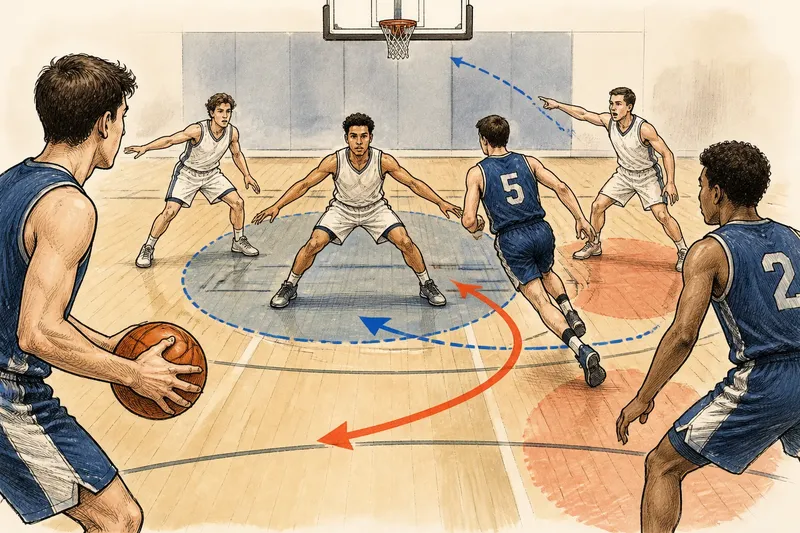
Zone defence vs man-to-man becomes easiest to read when an attacker cuts across the court: does a defender travel with them, or hand them to a teammate? One approach anchors responsibility to an opponent; the other anchors it to an area. That choice shapes what defenders watch, how they help and where an attack may find space.
Zone defence assigns areas while man-to-man assigns opponents
In man-to-man defence, each defender is primarily responsible for an assigned opponent. They track that player’s position and movement while staying alert to the ball, nearby teammates and possible help.
In zone defence, defenders protect areas rather than individual attackers. A defender watches for opponents entering or leaving their patch and may take whichever player becomes dangerous there. The boundaries and handover rules vary by sport and team.
Neither system means ignoring the rest of the court. The difference is what anchors a defender’s responsibility when opponents move: a particular player, or the space that player enters.
Zone defenders scan space and coordinate handovers
A zone defender watches the ball, attackers moving through their area and the next space an attack could exploit. Following only the ball can leave an opponent slipping into an unguarded pocket.
Communication makes area responsibility workable. Defenders may call out a cutter, signal that an opponent has crossed into another area or alert a teammate to someone settling in a threatening spot. Without a clear handover, two defenders can follow one attacker while another is left free.
Spacing matters, too. If attackers bunch on one side, defenders may need to protect an open lane rather than chase every player. The area is a starting assignment, not a reason to stand still as the play shifts.
Man-to-man defenders track assignments without losing the ball
A man-to-man defender keeps their assigned opponent in view while reading the ball. That balance helps them stay connected to the player without missing a pass, a teammate’s movement or a possible screen.
Position matters as much as pursuit. A defender might stand between an opponent and a useful route, stay close enough to challenge a pass or adjust when the ball moves away. Chasing directly behind every cut can give an attacker a clear path and make it harder for teammates to help.
Screens require a shared response. Defenders may follow through, switch assignments or use another agreed approach. The right choice varies by sport and team; individual assignments still depend on collective decisions.
A moving attacker reveals each defence’s responsibility
In man-to-man, the defender generally moves with their assigned opponent as that player cuts, retreats or changes direction. Teammates may help briefly, but they need a plan for returning to their own assignments.
In a zone, defenders usually protect their areas rather than crossing the court after an opponent. If an attacker moves into a teammate’s area, responsibility may pass across the formation. That handover can preserve the shape, but it needs clear calls and awareness of where the attacker is heading.
Say an invented basketball possession begins with the ball on the left wing, an attacker on the right wing and a middle defender responsible for the central area. The attacker cuts towards the middle. Under man-to-man, the assigned defender follows; the observable cue is that the same defender stays alongside the cutter as they cross the lane. Under a zone, the right-side defender calls the cut and the middle defender steps towards the lane while the first defender stays near the wing. The observable cue is a change of defender at the area boundary: the middle defender takes the cutter, while the first remains in position. The trade-off is clear: man-to-man keeps one defender attached to the opponent, while the zone preserves area coverage but depends on a clean handover.
Each defence can leave a different opening
There is no single answer to which defence is harder to attack. A zone can crowd central space while leaving gaps between areas for a patient attack to probe.
Man-to-man can make individual match-ups and direct movement easier to track, but attackers may use a screen, draw a defender away or exploit a mismatch. Those actions test whether defenders can stay connected without losing sight of the rest of the play.
For an attacker, the useful question is not simply which defence is weaker. Ask where it must make its next decision. A zone may have to choose which area to protect as the ball moves; man-to-man may need to respond when an assignment is screened or pulled out of position.
Teams choose a system to solve a particular problem
A coach may choose a zone to organise players around protected spaces and shared responsibility for opponents moving through them. That can suit a plan built around staying organised in relation to the ball, though zones differ across sports and teams.
Man-to-man may suit a plan that asks each defender to pressure or track a particular opponent. It gives players a clear starting responsibility, especially when they communicate well about screens and help. But an assignment does not remove the need to protect space.
The choice is not always absolute. A team may change its approach during a game or combine area coverage with individual assignments. To identify what is happening, watch how defenders respond when attackers cross paths rather than relying only on the formation’s name.
What cues answer common questions about defensive coverage?
How can I tell whether a team is playing zone?
Watch whether defenders tend to remain near particular areas as attackers move across them. If one defender lets a cutter continue and a teammate takes over at an area boundary, area responsibility is likely shaping the coverage.
How can I tell whether a team is playing man-to-man?
Look for defenders who continue to track specific opponents through changes of position. A brief switch or helping move does not necessarily change the whole defence; notice whether players return to their original assignments.
Can defenders combine zone and man-to-man?
Yes. A team can assign some defenders to particular opponents while others guard areas. Follow each defender’s responsibility through several changes in the attack to see how the arrangement works.
Does one approach always work better?
No. Each system asks defenders to notice different cues, and each can be challenged by movement that tests its responsibilities. The stronger choice depends on the game plan, communication and the problem the defence is trying to solve.
Watch these cues to read the next defensive decision
Follow the handovers as well as the ball. If defenders exchange a cutter between areas, the zone’s organisation is visible; if one defender stays with the same opponent through a change of direction, an individual assignment is doing more of the work.
Then notice what happens when two attackers occupy the same space or one moves away from the ball. Defenders may compress towards a threat, hold their positions or pass responsibility to a teammate. Those reactions reveal how the team understands its rules more clearly than a formation alone.
It is not worth identifying a defence from one frozen moment. A single view can make a zone defender look as though they are following an opponent, or make a man-to-man defender seem stationary while their assignment moves elsewhere. Watch several linked actions and ask who takes responsibility for the space each attacker enters.
To read zone defence vs man-to-man, track one defender as the ball shifts: do they protect a patch of court or stay with a person? Then watch whether a teammate takes over when paths cross. That second cue often shows not just what the defence is, but how its players handle the decision that can expose it.